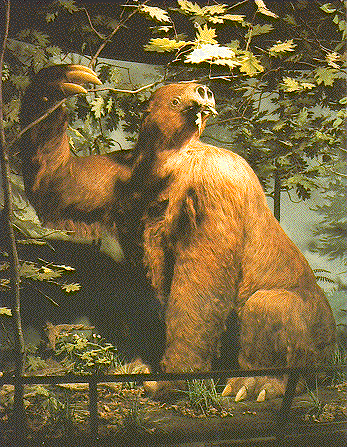
Four species of ground sloths inhabited the United States at the end of the last Ice Age. These were Jefferson's ground sloth (Megalonyx jeffersonii), Laurillard's ground sloth (Eremotherium laurillardi), the Shasta ground sloth (Nothrotheriops shastensis), and Harlan's ground sloth (Glossotherium harlani). Of these four only two, Jefferson's and Harlan's ground sloths, are found in Georgia.
Ground sloths were large relatives of the modern two-toed sloths (Choloepus spp.) and three-toed sloths (Bradypus spp.). Unlike modern sloths, which spend most of their time in trees, the ground sloths spent all of their time on the ground. This is fortunate because Jefferson's and Harlan's ground sloth were each about the size of an oxen.
All four species of ground sloth had very large claws. However, all were herbivores. They had relatively small, blunt teeth, which they probably used for browsing on trees and shrubs. The shape of their hip bones indicates that they could stand up on their hind legs. This would allow them to reach high up into trees for the best leaves and twigs.
Harlan's ground sloth is reconstructed as looking quite similar to Jefferson's, but was a grazing form. This reconstruction of a Harlan's ground sloth is in the museum at Mastodon State Historic Site near Kimmswick, Missouri. The Historic Site is located at the Kimmswick Site. This archaeological site is one of the most intriguing sites known dating from the time of the Clovis people.
Evidence found at the Kimmswick Site has been used by some researchers to suggest that the Clovis People may have used the hides of the Harlan's ground sloth (Graham and Kay, 1988).
Ground sloths were large relatives of the modern two-toed sloths (Choloepus spp.) and three-toed sloths (Bradypus spp.). Unlike modern sloths, which spend most of their time in trees, the ground sloths spent all of their time on the ground. This is fortunate because Jefferson's and Harlan's ground sloth were each about the size of an ox.
All four species of ground sloth had very large claws and small, blunt teeth. They all were herbivores and probably used the teeth for browsing on trees and shrubs. The shape of their hip bones indicates that they could stand up on their hind legs. This would allow them to reach high up into trees for the best leaves and twigs.

The bone on the left is the finger bone (phalanx) that supports the claw on the thumb of a Jefferson's ground sloth. The specimen on the right is a tooth, also from a Jefferson's ground sloth.
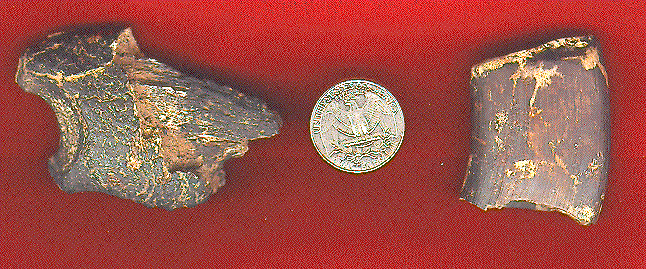
Both of these specimens were recovered from Heinze Cave, Jefferson County, Missouri. Radiocarbon dating indicates that both specimens are more than 40,000 years old.
All four species of ground sloth became extinct in North America approximately 10,000 years ago. The reason for their extinction is being studied by paleontologists.
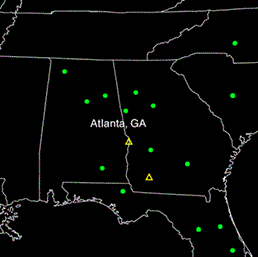
This map shows some of the important ground sloth finds in the region. Green dots represent Jefferson's ground sloth finds, and yellow triangles represent Harlan's ground sloth finds.
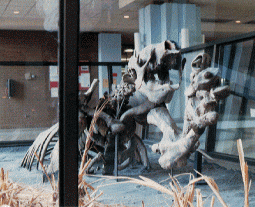
The skeleton of a giant North American sloth that roamed coastal Georgia 14,000 years ago has been assembled at the University of Georgia. Measuring about 13 feet in length and weighing between 2,500 and 3,000 pounds, the skeleton is the first of a prehistoric animal ever put together in Georgia and only the fourth North American ground sloth known to have been mounted anywhere. The bones, discovered in 1970 during the construction of Interstate Highway 95 near Brunswick, were excavated by college students. The skeleton is on display in the Boyd Graduate Studies Research Center on the campus.
More information on Ground Sloths can be found at the La Brea Tarpits Web site, and at the Academy of Natural Sciences Museum.
A Giant Sloth Mystery Brought Me Home to Georgia by G. Wayne Clough